⌘K
Change language Switch ThemeSign In
Narrow Mode
Parkinson's Law of Worry — LessWrong
L LessWrong @Jakub Halmeš
One Sentence Summary
The author proposes that worry is elastic: as major problems are resolved, minor ones expand to fill the available mental capacity, suggesting that active perspective-taking is necessary to maintain emotional equilibrium.
Summary
The article draws a parallel between Parkinson's Law and human psychology, arguing that 'problem salience expands to fill the capacity available for worrying.' When significant life problems are resolved, individuals often find that their mental space is quickly occupied by previously minor or new concerns rather than achieving a state of reduced worry. The author suggests that this phenomenon is a form of hedonic adaptation and proposes a practical cognitive strategy: periodically recalling past resolved problems to re-calibrate the relative importance of current stressors.
Main Points
* 1. The elasticity of worrySimilar to Parkinson's Law, the mental capacity for worry appears constant. When major problems are resolved, the mind naturally allows smaller, previously ignored issues to expand and occupy that freed mental space. * 2. The illusion of future reliefIndividuals often mistakenly believe that solving current major problems will lead to a proportional reduction in overall worry. In reality, the mind tends to find new sources of concern to maintain its baseline level of worry. * 3. Cognitive recalibration as a solutionTo mitigate this, the author suggests actively practicing negative visualization or periodically recalling past resolved problems. This helps maintain perspective and prevents minor issues from being perceived as disproportionately significant.
Metadata
AI Score
85
Website lesswrong.com
Published At Today
Length 340 words (about 2 min)
Sign in to use highlight and note-taking features for a better reading experience. Sign in now Parkinson’s law says that _"Work expands so as to fill the time available for its completion."_ I think that a similar observation can be made for people worrying about stuff. To paraphrase: "_Problem salience expands so as to fill the capacity available for worrying.”_
Suppose a person is worried about several problems. Let’s visualize the mental state of this person, where each problem is represented by a colored circle, and the size of the circle corresponds to how much this problem occupies the person:
[](https://image.jido.dev/20260329140502_d9d49f4e-305f-438f-bce3-0711bf9317fb_629x629.png)  This person worries about 5 things, with the yellow and green ones being the most important ones.
Now, when one of these problems is resolved, one would expect that this problem simply gets removed from the ‘mental space’, making the person less worried in proportion to the size of the resolved problem:
[](https://image.jido.dev/20260329140502_b76f11a0-2dfe-46f7-bddf-1e8868df6590_629x629.png) 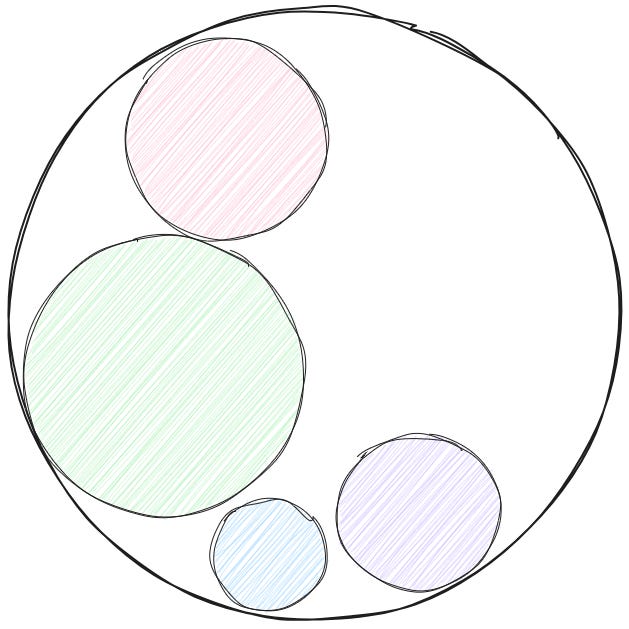 Naive expectation: The person now worries less, because the big problem was resolved.
However, I don’t think this accurately describes what actually happens! Instead, it seems that the unresolved problems become more salient to the person, as if to fill the available space in the person’s mental state:
[](https://image.jido.dev/20260329140502_1c6f264e-5b76-4779-bd1b-2b7e160ba428_629x629.png) 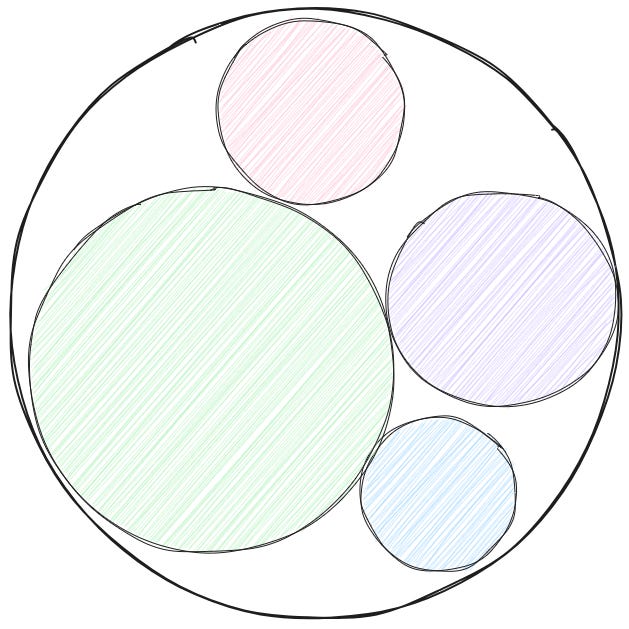 Or, new problems pop inside the freed space — the problems which weren’t important enough to worry about as long as there were more pressing ones:
[](https://image.jido.dev/20260329140502_a97baed2-a9fd-4b87-ae5e-3c99396955f3_629x629.png)  The upshot is that in the beginning, the person would be wrong to think that they will worry much less or be much happier after the most important problems are resolved. They will just worry about different things!
What could help to prevent this scenario is to try to periodically recall some of the resolved problems and the amount of worrying they caused before they were resolved. By remembering this, the importance of other problems can shrink again (it’s relative, so they should still be less important than the yellow problem was!). 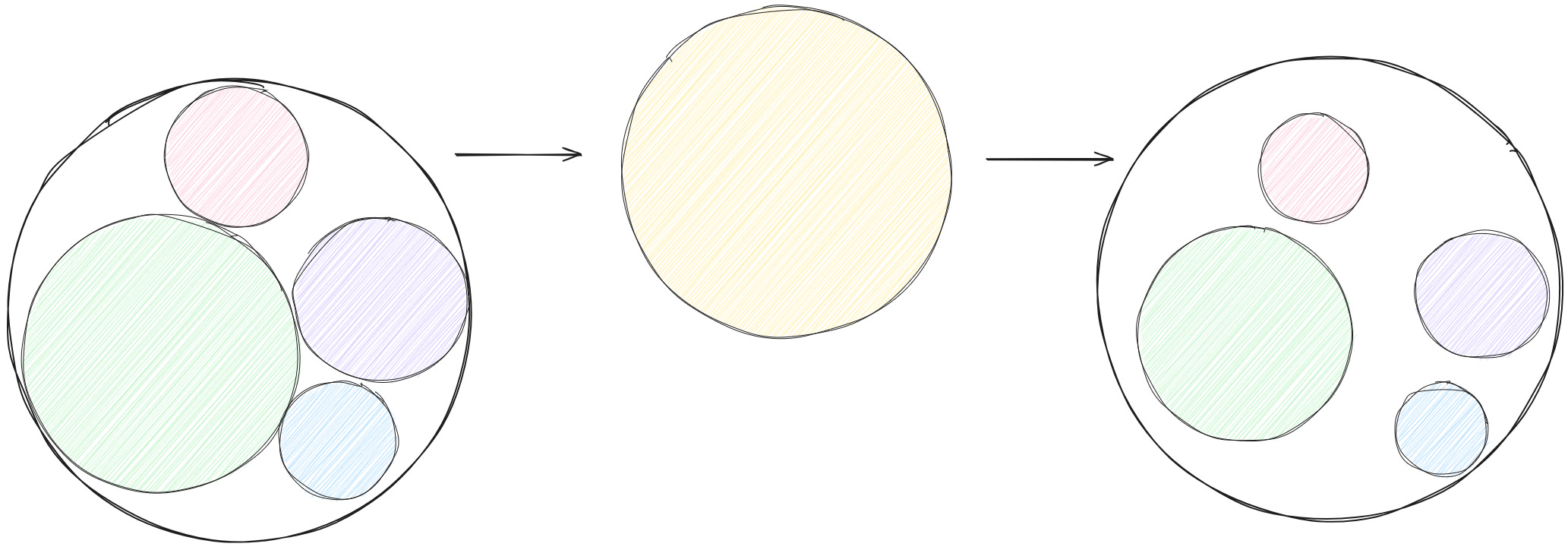 * Related concepts:_Adaptation level theory, hedonic treadmill, gratitude, negative visualization._
L LessWrong @Jakub Halmeš
One Sentence Summary
The author proposes that worry is elastic: as major problems are resolved, minor ones expand to fill the available mental capacity, suggesting that active perspective-taking is necessary to maintain emotional equilibrium.
Summary
The article draws a parallel between Parkinson's Law and human psychology, arguing that 'problem salience expands to fill the capacity available for worrying.' When significant life problems are resolved, individuals often find that their mental space is quickly occupied by previously minor or new concerns rather than achieving a state of reduced worry. The author suggests that this phenomenon is a form of hedonic adaptation and proposes a practical cognitive strategy: periodically recalling past resolved problems to re-calibrate the relative importance of current stressors.
Main Points
* 1. The elasticity of worry
Similar to Parkinson's Law, the mental capacity for worry appears constant. When major problems are resolved, the mind naturally allows smaller, previously ignored issues to expand and occupy that freed mental space.
* 2. The illusion of future relief
Individuals often mistakenly believe that solving current major problems will lead to a proportional reduction in overall worry. In reality, the mind tends to find new sources of concern to maintain its baseline level of worry.
* 3. Cognitive recalibration as a solution
To mitigate this, the author suggests actively practicing negative visualization or periodically recalling past resolved problems. This helps maintain perspective and prevents minor issues from being perceived as disproportionately significant.
Key Quotes
* Problem salience expands so as to fill the capacity available for worrying. * The upshot is that in the beginning, the person would be wrong to think that they will worry much less or be much happier after the most important problems are resolved. They will just worry about different things! * What could help to prevent this scenario is to try to periodically recall some of the resolved problems and the amount of worrying they caused before they were resolved.
AI Score
85
Website lesswrong.com
Published At Today
Length 340 words (about 2 min)
Tags
Cognitive Science
Mental Models
Productivity
Psychology
Stress Management
Related Articles
* How well do models follow their constitutions? — LessWrong * Marc Andreessen: This is the most important era in tech history (here’s why) * “Anyone can cook”: How v0 is bringing git workflows to vibe-coding | Guillermo Rauch (Vercel CEO) * Latent Introspection (and other open-source introspection papers) * Letting Claude do Autonomous Research to Improve SAEs — LessWrong architectures, achieving near-perfect scores on a synthetic benchmark by rediscovering and adapting classical dictionary learning techniques.") * Claude Code, Claude Cowork and Codex #5 — LessWrong * Sycophancy Towards Researchers Drives Performative Misalignment — LessWrong is a dominant factor in Llama-3.1 70B, challenging the assumption that such behavior is primarily driven by spontaneous, strategic scheming.") * 10x Productivity: How Claude Code Cleared My Entire Product Backlog * Andrej Karpathy's Reflections on the LLM-Driven Coding Paradigm Shift * Learn to Learn in 58 Minutes HomeArticlesPodcastsVideosTweets